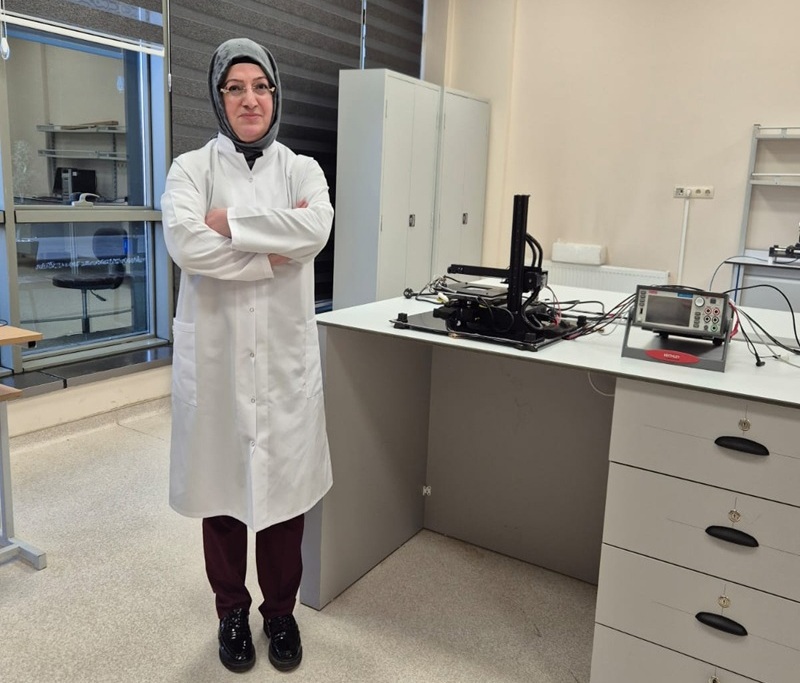
he invention titled " Measurement Station for Photonic Devices or Components," developed under the leadership of Prof. Dr. Songül DUMAN, a faculty member of the Basic Engineering Department of our faculty, has been granted a utility model certificate by the Turkish Patent and Trademark Office with registration number TR 2024004241 Y.
The utility model, developed in partnership with Erzurum Technical University, was created by Muhammed Canhakan Bodur and Oğuzhan Akar, while the inventors are Prof. Dr. Songül Duman, Muhammed Canhakan Bodur, Mehmet Salih Akıncı, and Oğuzhan Akar. In the initial stages of the project, the development process was initiated with the support of the "ETÜ Crystal Entrepreneurship Center," and later, the work progressed under the company structure established within the technopark, resulting in the completion of the device. Prof. Dr. Songül Duman 's leadership and guidance played a significant role in the successful completion of the project.
The system features a three-axis stepper motor-controlled autonomous motion mechanism, a thin-tipped spring probe structure, an integrated illumination unit, and a user interface that allows for measurement management. The device's main innovation is its camera-based image processing infrastructure, which enables the probe to be positioned autonomously and precisely at the target point where measurements are to be taken. The center of the generated device is determined via the user interface, and these points are converted into coordinate information, allowing the probe to be automatically directed to the relevant measurement point.
The image obtained by the system is processed in a software environment to eliminate perspective-induced deviations that may negatively affect measurement accuracy, and necessary geometric corrections are applied. Thus, thanks to this developed structure, compared to existing manual systems, the measurement time is shortened, the probability of human error is reduced, the probe is ensured to contact the target point accurately and stably, and the risk of damaging the sample during measurement is minimized.
As the Faculty of Science, we congratulate our professor and his team on their achievements.
 Merhaba, ben Kartanesi sana yardımcı olabilmek için burdayım, Yapmak istediğin işlemi seçebilir misin?