Department of Electrical and Electronic Engineering
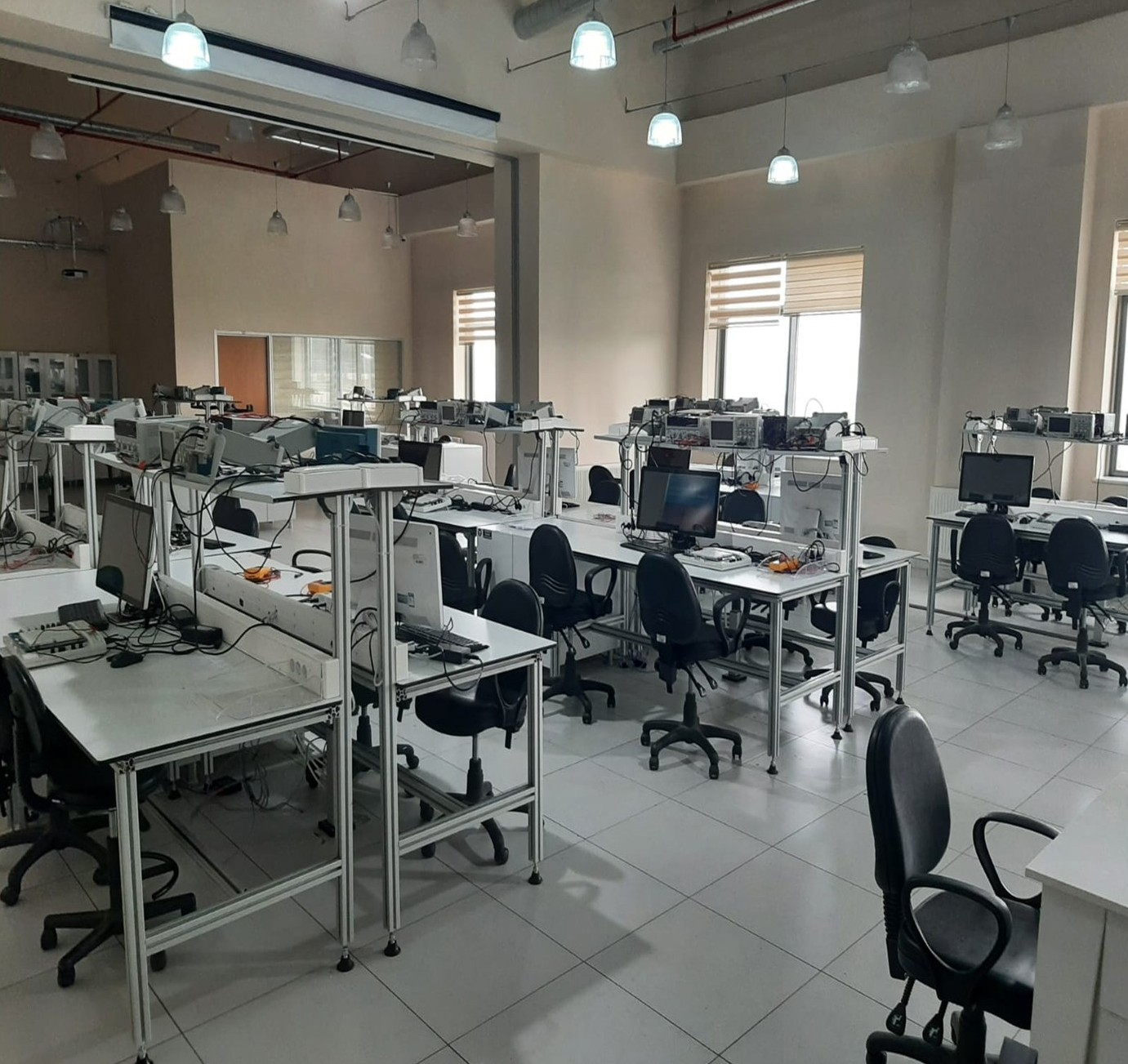
Electronics Laboratory
The Electronics Laboratory is one of the fundamental educational laboratories that allows students to learn the working principles of analog and digital electronic circuits through hands-on experience. Experiments are conducted in the laboratory on diodes, transistors, operational amplifiers, power electronics components, and various analog/digital circuits. Students learn the design, installation, measurement, and analysis processes of electronic circuits through practical application; they gain experience in the effective use of measuring instruments, error analysis, and interpretation of experimental results. The laboratory infrastructure supports the practical work of Electronics I-II, Analog Electronics, Digital Electronics, Power Electronics, and Measurement courses.
Experiments that can be performed
- Diode Characteristics
- Zener Diodes and Voltage Regulation
- BJT Transistor Characteristics
- FET and MOSFET Characteristics
- Common Emitter and Common Collector Amplifiers
- Operational Amplifier Applications
- Adder, Subtractor, and Comparator Circuits
- Active and Passive Filter Designs
- RC, RL, and RLC Circuit Analyses
- Oscillator Circuits
- Rectifier and Power Supply Circuits
- Regulator Circuits
- Frequency Response and Bode Analysis
- Measurement and Error Analysis in Electronic Circuits
Electronics Laboratory Equipment List
1. Tektronix TBS 1152B-EDU Digital Oscilloscope
- 150 MHz bandwidth
- 2 analog input channels
- Sampling rate of 2 GS/s
- FFT (Fast Fourier Transform) analysis
- Automatic amplitude, frequency, and phase measurements.
- Ability to analyze analog and digital signals.
2. GW Instek GPS-4303 DC Power Supply
- 4 independent output channels
- 0–30 V / 0–3 A adjustable outputs
- Support for serial and parallel operation.
- Low noise and stable output structure.
- Overcurrent and short circuit protection
3. GW Instek AFG-2225 Function Generator
- 25 MHz output frequency
- Dual channel signal generation
- Sine, square, triangle, and pulse waveforms.
- AM, FM, FSK, and Sweep modes
- Suitable structure for frequency response analysis of electronic circuits.
4. Fluke 175 True-RMS Digital Multimeter
- True-RMS AC/DC measurement capability
- Measurement of voltage, current, resistance, and frequency.
- Diode and continuity test
- High measurement accuracy.
- Structure compliant with industrial safety standards.
5. LCR-9184 Precision LCR Meter
- Measurement of inductance (L), capacitance (C), and resistance (R).
- Impedance and phase angle measurements
- Quality factor (Q) and loss factor (D) measurements
- Multiple test frequency support
- Electronic component characterization
Thanks to this laboratory, students reinforce the theoretical foundations of electronic circuits through practical work, learn to effectively use modern measuring instruments, and acquire the necessary engineering skills in the design, analysis, and testing processes of electronic systems. Furthermore, the laboratory provides the experimental infrastructure required for student projects, graduation theses, and research activities.
 Merhaba, ben Kartanesi sana yardımcı olabilmek için burdayım, Yapmak istediğin işlemi seçebilir misin?